
The best Capture One alternative for tethering on location, without a laptop
If you love Capture One in the studio but what you need on location is every shot off the camera, backed up and delivered to a client folder, a gallery or an FTP server while you're still shooting, the best Capture One alternative for that job is a phone. CloudTether tethers Canon, Nikon, Sony and Fujifilm cameras to an iPhone, iPad or Android phone over USB-C or Wi-Fi and sends every full-resolution frame onward automatically.
Capture One stays the better tool for on-set editing, live view and colour work. Here's what it does well, why people look for something else on location, and how to add CloudTether in three steps.
7-day free trial · iPhone, iPad and Android · facts checked October 2026
Cloud storage
Galleries & proofing


Messaging
Transfer & servers
What Capture One is
Capture One is professional raw-processing and editing software with excellent tethered capture — shooting straight into a session on a Mac, Windows PC or iPad for live preview, culling and colour work, the studio standard for many photographers.
Where CloudTether is different
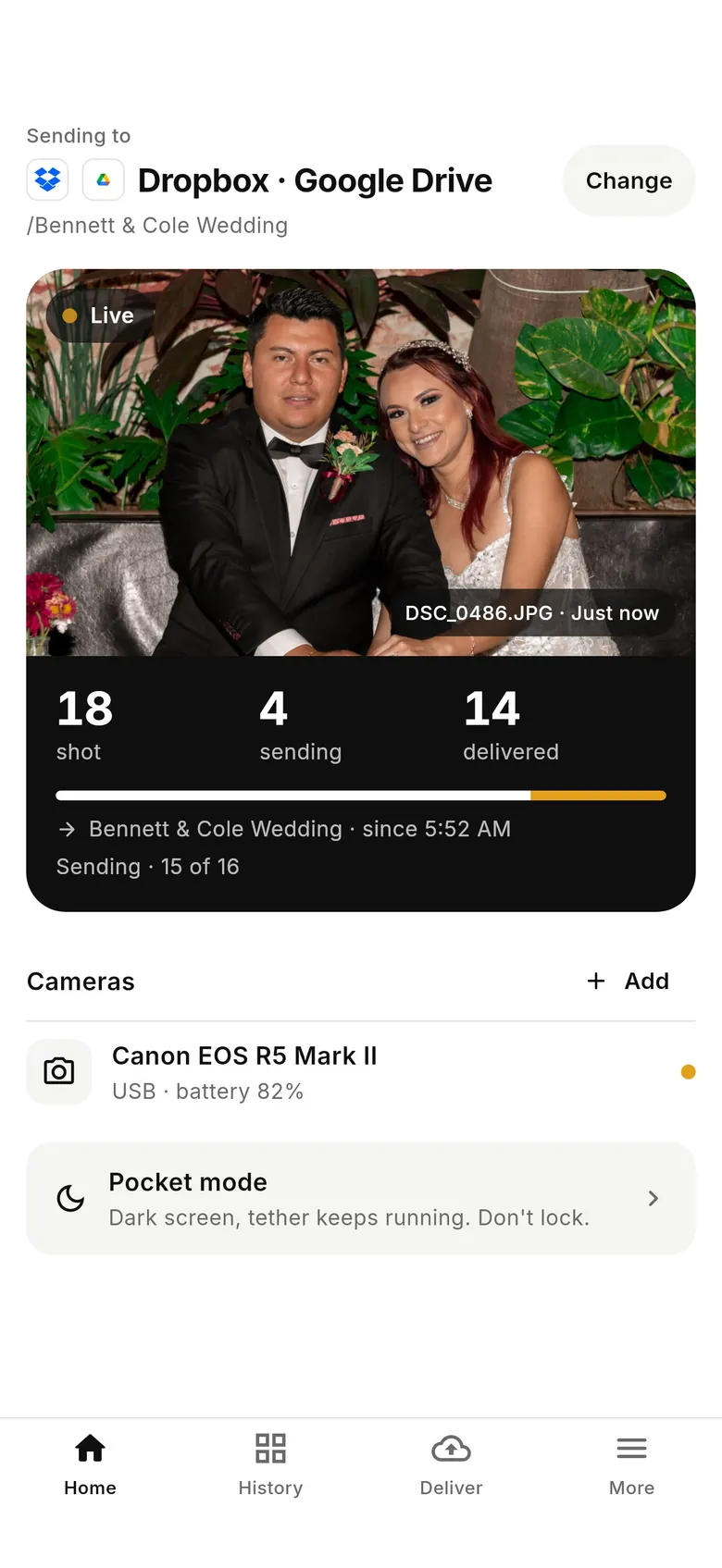
Capture One's tethering is built around capture and editing on a computer or iPad. CloudTether is phone-based and built around delivery: it gets every shot off the camera and to the cloud, a gallery or a server in real time, without a laptop on location — useful exactly where a desktop tether isn't practical, like weddings, events and the field.
What Capture One does well
- Tethered capture is Capture One's heritage: shots land in a session for live review on a big screen, with naming, location and adjustments applied to each new capture, plus live view and camera control on supported bodies.
- Its colour tools, styles and layers make it a favourite for commercial, product and fashion work where the client watches the grade on set.
- Capture One for iPad tethers over USB-C and wirelessly with selected cameras, and the mobile app also runs on iPhone; Capture One Live shares a session with remote clients.
Why people look for a Capture One alternative
These are the issues photographers most often search for — common, well-documented ones, not a verdict on the app. Many have fixes, and it's worth trying them first.
A computer or iPad on set
Desktop tethering means a laptop, a cable run, power and a table or cart. The iPad app is lighter, but it's still another device to mount, charge and watch.
No Android
Capture One's mobile apps are for iPad and iPhone, and Capture One says it has no plans for Android. Teams on Android phones need something else.
Delivery is a separate step
Shots land in a session for editing. Getting every frame to a client's Dropbox, a gallery or a newsroom server while you're shooting is up to you.
Camera support is per model
Tethering and live view are listed model by model, wireless only on selected cameras, and new bodies arrive in updates — so check before you buy a camera or a plan.
Capture One vs CloudTether, side by side
| Feature | Capture One | CloudTether |
|---|---|---|
| What it is | Raw editor with tethered capture | A phone app for capture and delivery |
| Runs on | Mac, Windows, iPad, iPhone | iPhone, iPad, Android |
| Connection | USB; wireless on selected cameras | USB-C cable or the camera's Wi-Fi (verified on Canon) |
| Cameras | A broad multi-brand list, model by model | Canon, Nikon, Sony, Fujifilm |
| Live view and remote control | Yes, on supported cameras | No — you shoot on the camera |
| Where photos go | A session on the computer or iPad | The phone, plus cloud storage, galleries, FTP/SFTP or S3 — several at once |
| Editing | Full raw editing and styles | None — deliver originals, JPEGs only or resized copies |
| Pricing model | Subscription or licence | 7-day free trial, then a subscription |
Based on vendor pages, app-store listings and press coverage as of October 2026. Features vary by camera and app version — check Capture One's own documentation for your model. Product names are trademarks of their owners.
Should you switch?
Switch to CloudTether if…
- You're on location and need every frame backed up and delivered, not graded on set.
- Photos must reach Dropbox, Google Drive, SmugMug, ShootProof or an FTP/SFTP server during the shoot.
- You or your second shooter use Android phones.
- You want to tether two or three bodies to one phone at once.
Stick with Capture One if…
- You grade and cull on set with a client watching a calibrated screen.
- You need live view, remote shutter or camera control — CloudTether has none of these.
- Your camera is a medium-format back or a body only Capture One supports.
Plenty of photographers keep both: Capture One for what it's best at, CloudTether for getting every frame delivered.
How to switch in 3 steps
Install CloudTether, then:
- 1
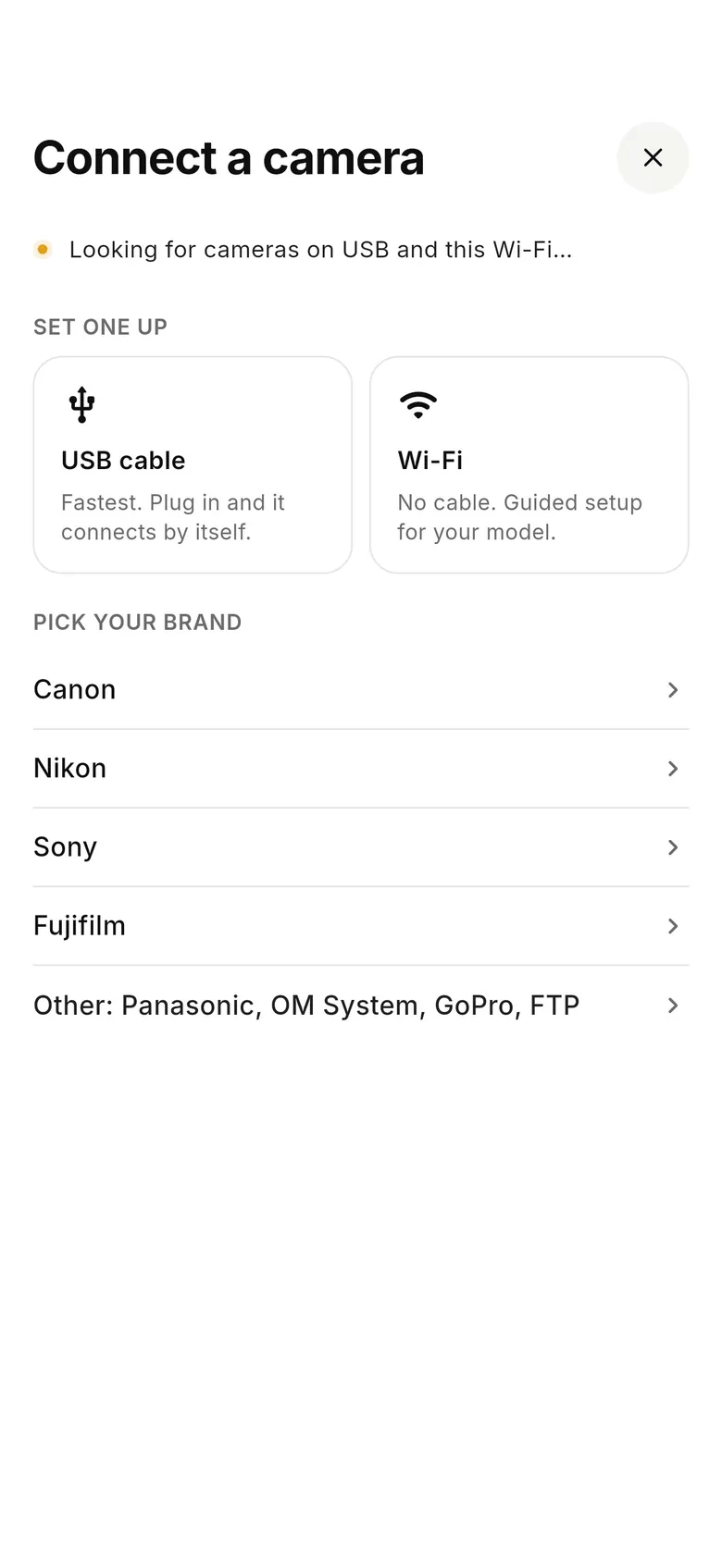
Connect the camera to your phone
Tap “Connect a camera” and plug in a USB-C cable (PC Remote on Sony, USB tether on Fujifilm; turn a Canon's Wi-Fi off first), or use Wi-Fi on a Canon with “Remote control (EOS Utility)”.
- 2
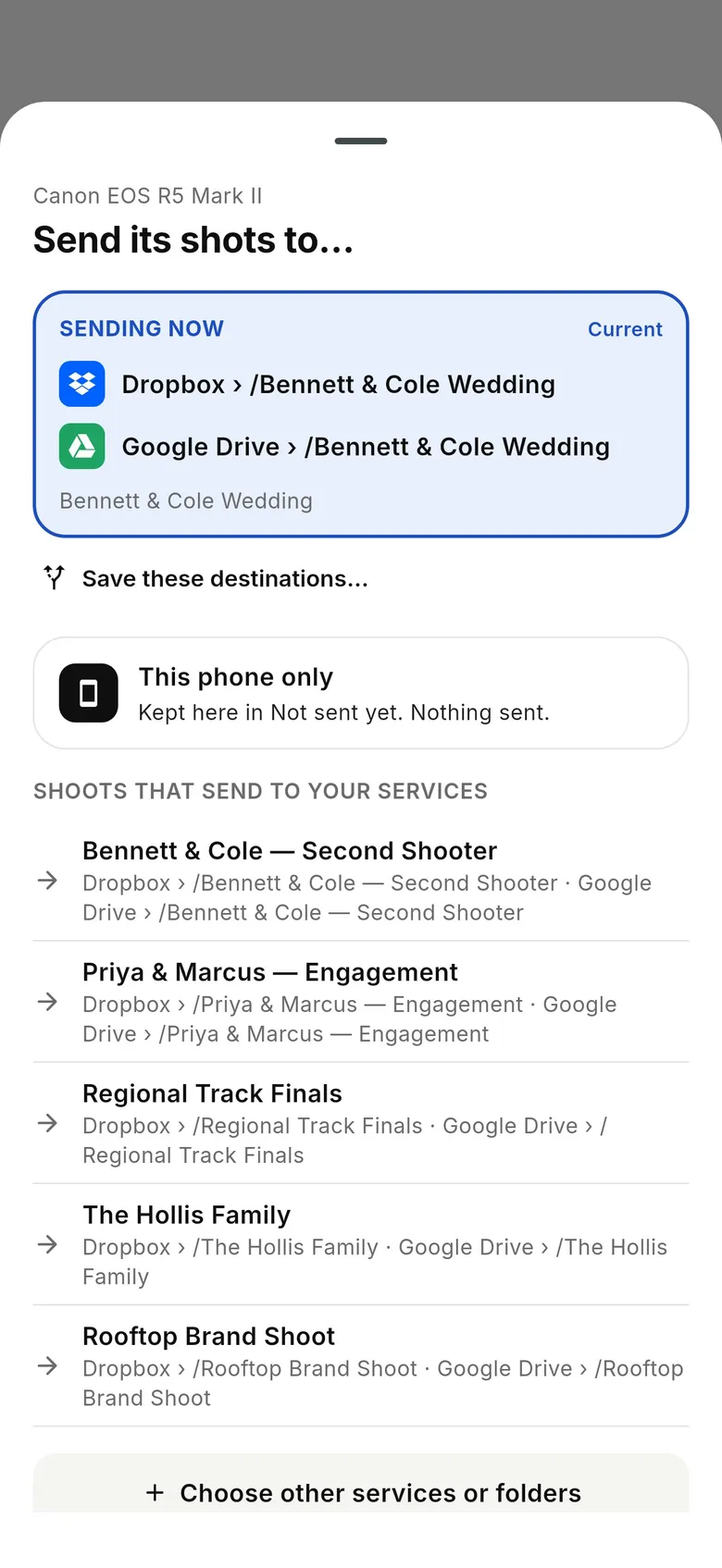
Choose where shots go
Pick the services the camera's shots go to — a client's Dropbox, a Google Drive folder that syncs to your editing machine, a gallery or an FTP/SFTP server.
- 3
Shoot, then edit in Capture One
Every frame comes off at full resolution and is delivered as you shoot. Back at your desk, import the synced folder into a Capture One session and grade as usual.
Why photographers choose CloudTether
- Auto-delivers every shot to the cloud — Dropbox, Google Drive, SmugMug, ShootProof, FTP and more — seconds after the shutter.
- Runs on the iPhone, iPad or Android you already own — nothing extra to set up or power on location.
- Works across Canon, Sony, Nikon and Fujifilm from a single app.
- Upload once, fan out to multiple destinations in one session.
- Uploads over your phone's mobile data — no venue Wi-Fi required.
- Shoot into an album on your phone with no signal — uploads catch up automatically when you're back online.
Capture One alternative FAQ
What is the best alternative to Capture One for tethering?
In the studio, Lightroom Classic or the camera maker's free software tether to a computer. On location, if what you need is every shot backed up and delivered rather than edited on set, CloudTether tethers to iPhone, iPad or Android and sends each frame to the cloud as you shoot.
Is CloudTether a replacement for Capture One?
No — Capture One is a capture-and-edit application. CloudTether is a delivery tool: it tethers your camera to your phone and pushes every shot to the cloud in real time, without a laptop. Many photographers use both.
Is there a Capture One alternative for Android?
Capture One has no Android app and says it has no plans for one. CloudTether runs on Android phones and tablets as well as iPhone and iPad.
Can I tether without a laptop?
Yes — that's the point of CloudTether. Your phone is the only device you need on location; photos upload over its connection as you shoot.
Does CloudTether have live view like Capture One?
No. CloudTether has no live view or remote shutter — you shoot on the camera and every frame comes off it automatically. Keep Capture One for live view and on-set grading.
Which cameras does CloudTether support?
Canon, Nikon, Sony and Fujifilm. USB tethering is verified on the Canon EOS R7 and R5 Mark II, Nikon Z6, Sony ZV-E10 and Fujifilm X-T3; Wi-Fi is verified on Canon and experimental on Fujifilm.
Can I get CloudTether photos into Capture One later?
Yes. Deliver to a Dropbox, Google Drive or OneDrive folder that syncs to your computer, then import from it into a Capture One session when you edit.
See it for yourself
Install CloudTether, connect your camera and take a test shot — it'll be on your phone and on its way before you lower the camera. Start with a 7-day free trial.
Read next
- Capture One tethering on desktop, iPad and iPhone
- Best camera tethering software (2026)
- Camera tethering app for iPad
- Lightroom tethering: how to tether your camera
Comparing more tools? See the best camera tethering software roundup.
More comparisons