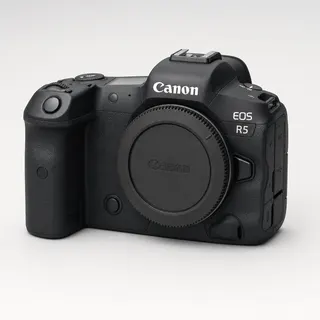
Canon EOS R5 to Google Drive: auto-upload as you shoot
Tether your Canon EOS R5 to your phone over USB or Wi-Fi and deliver every shot straight to Google Drive the instant you press the shutter — no laptop, no SD-card import. Shared Drives for teams already on Google Workspace.
By the CloudTether team · Updated

How it works for Canon EOS R5 → Google Drive
Your phone sits between the camera and Google Drive: no laptop, no card reader.
 Step 1Canon EOS R5
Connect it to your phone with a USB-C data cable or over Wi-Fi, then shoot as normal.
- Step 2Your phone
CloudTether copies each full-resolution photo off the camera seconds after the shutter and uploads it once.
- Step 3Google Drive
Every shot lands in Google Drive while you keep shooting — and in any other destination on the shoot.
How to live-upload Canon EOS R5 photos to Google Drive
Connect your Canon EOS R5 to your phone and every shot lands in Google Drive live as you shoot. Here's the full setup, start to finish:
- 1
Connect your Canon EOS R5
Connect over USB with the camera set to PC/tether mode for the most reliable, fastest link. Or go wireless with the camera's “Remote control (EOS Utility)” Wi-Fi function — not “Connect to smartphone” — on the camera's own network, your phone's hotspot or a shared router. On a first wireless connection, approve the link on the camera body when prompted.
- 2
Connect Google Drive
Connects via Google OAuth — scoped to a folder you choose. Pick where photos should land — route per-session folders into a Shared Drive so the whole team has instant access.
- 3
Shoot as normal
Every frame your Canon EOS R5 captures is detected and downloaded at full resolution while you keep shooting — JPEG, or RAW.
- 4
Photos deliver to Google Drive
Each photo uploads from your phone once and lands in Google Drive live, seconds after the shutter — and fans out to any other destinations on the session too.
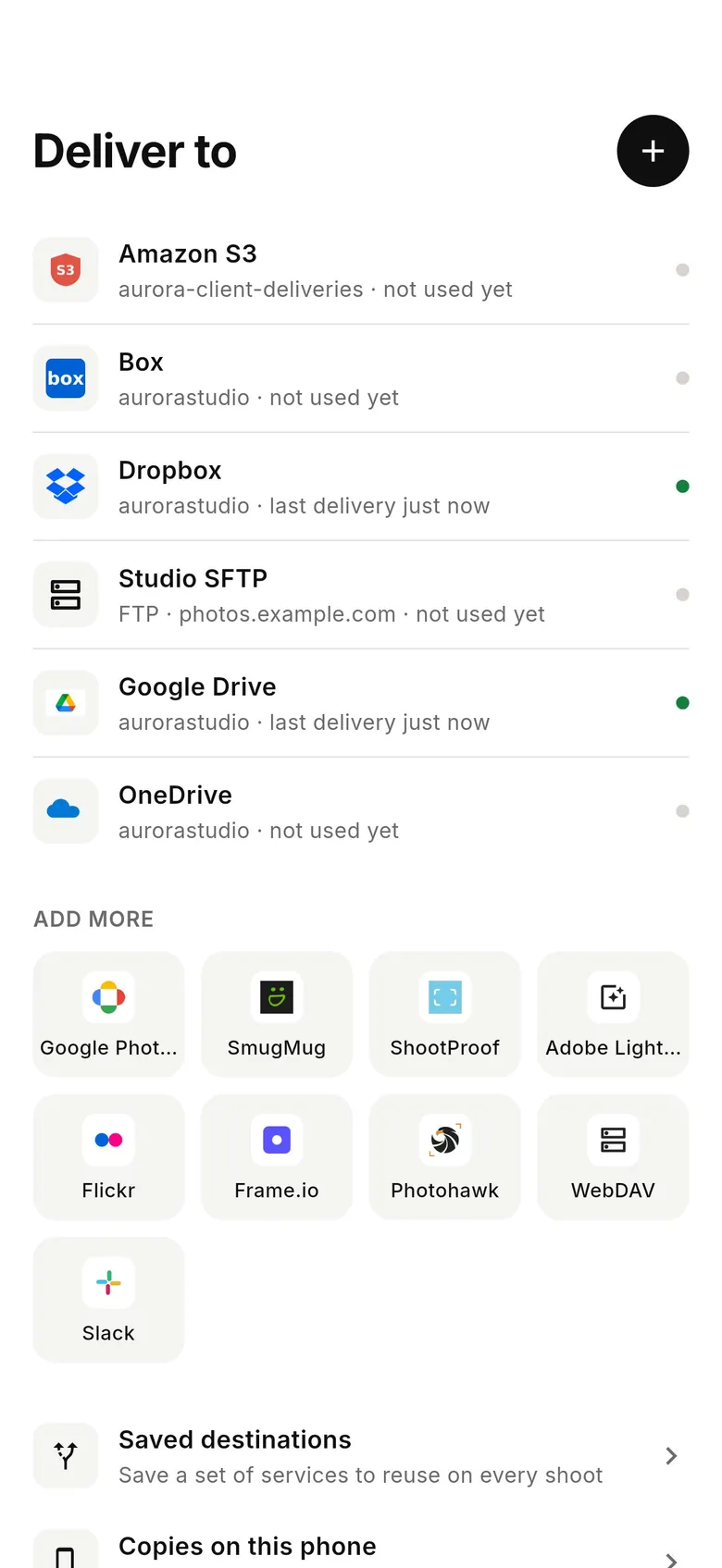
Google Drive in the CloudTether app
Connect Google Drive once, then every shoot from your Canon EOS R5 can deliver to it.
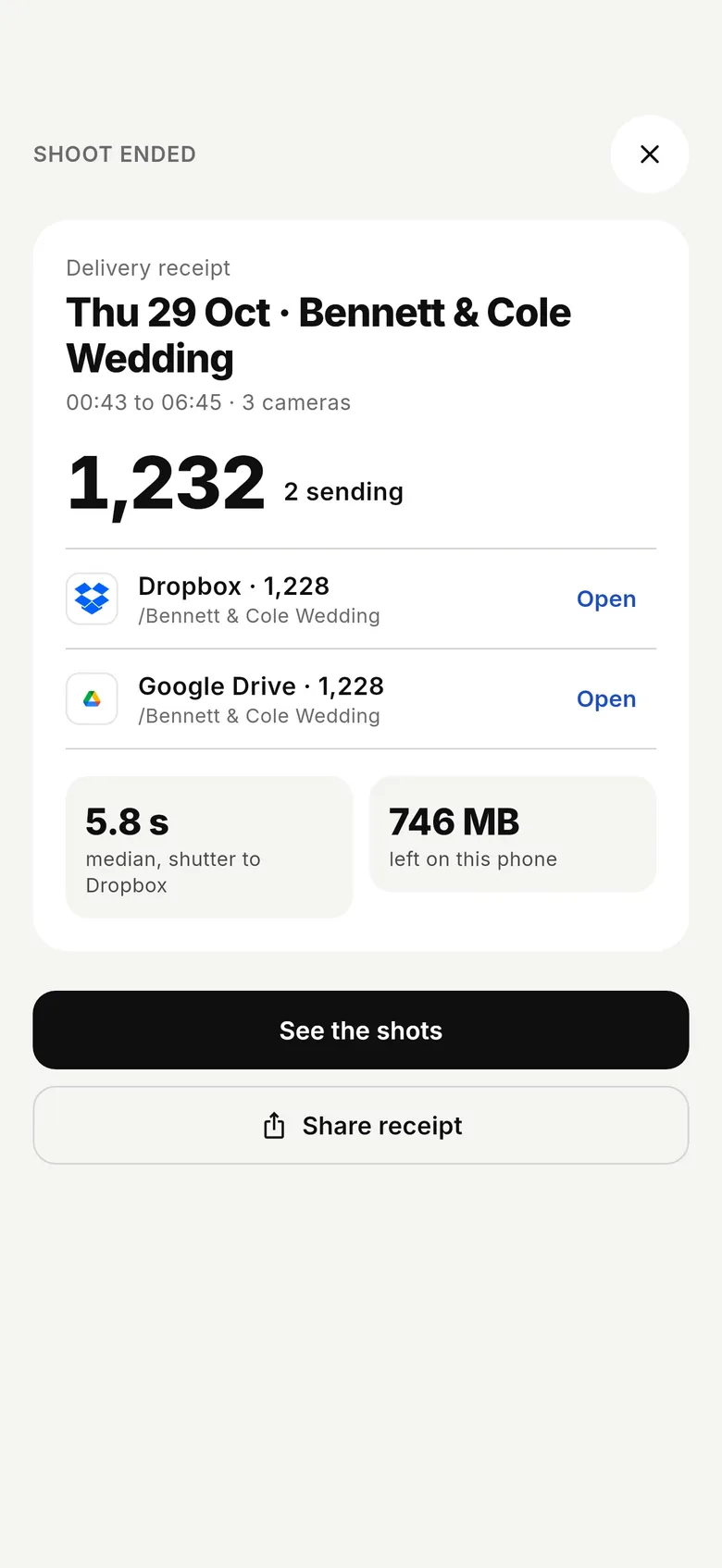
Connecting the Canon EOS R5
The EOS R5 has a USB-C port, so it plugs straight into a USB-C iPhone, iPad or Android phone with one USB-C to USB-C data cable; a Lightning iPhone needs Apple's Lightning to USB 3 Camera Adapter and a USB-C to USB-A cable. There's no USB mode to pick on EOS bodies. Switch the R5's wireless functions off — Canon disables USB communication while Wi-Fi is on — make sure it isn't in a webcam or streaming mode, and plug in. CloudTether opens the camera by itself.
For Wi-Fi, go to MENU → Wireless features → Wi-Fi/Bluetooth connection → Remote control (EOS Utility) — not the smartphone connection — join the camera to your phone's hotspot or the same router, and approve the pairing on the camera. Canon Wi-Fi pairing is verified in CloudTether on the EOS R7; the R5 speaks the same EOS protocol, but we haven't tested its Wi-Fi ourselves, so treat the cable as the default for paid work.
The R5 writes big CR3 RAW files. Canon's C-RAW setting makes smaller CR3s, and RAW+JPEG with CloudTether's “JPEG only” option leaves the RAW on the card altogether. Rated send works on Canon: rate frames in playback and, with “Only shots I rate in camera” on, only those leave the camera.
Who shoots it: wedding, portrait and commercial photographers who need high resolution — exactly the work where a client gallery or an editor is waiting on files. For those jobs, pair the R5 with a storage destination for the CR3 files and a gallery or shared folder for the JPEGs.
Getting the most out of Google Drive
Google Drive stores every file untouched — CR3, NEF, ARW, RAF and JPEG — in a folder you choose, with a folder per shoot inside it, and CloudTether's Google access is scoped to that folder. Teams on Google Workspace can route shoots into a Shared Drive, so editors, producers and the client's comms team all see each frame without being invited file by file.
Drive previews JPEGs instantly in a browser or the Drive app; RAW files are there to download into Lightroom or Capture One later. If people will look at photos on their phones during the event, send JPEGs or 2048 px copies to that folder and keep the RAW in a separate backup.
For a press office or agency, a Drive folder is often the hand-off the client already uses: editors open it in a browser, search by name or date and download what they need. Because each shoot gets its own folder inside the one you picked, a multi-day conference stays organised by day without sorting afterwards. If the organisation restricts third-party apps, a Workspace admin may need to allow CloudTether before you can pick a Shared Drive.
- Share the parent folder once — shoot folders created inside it inherit its sharing.
- Uploads count against the Google account's or Shared Drive's storage.
- Drive works over mobile data, so no venue Wi-Fi is needed.
A typical Canon EOS R5 to Google Drive workflow
- Ask the client's team which Google Drive folder or Shared Drive they want, and choose it as the destination's folder in CloudTether.
- Tether the R5 over USB-C, shoot RAW+JPEG, and send JPEGs (or 2048 px copies) to the shared Drive folder so the comms team can post straight away.
- Add a second destination for the CR3 files — your own Drive folder or Dropbox — so the full-resolution RAW is backed up without crowding the client's folder.
Canon EOS R5 to Google Drive: what to know
The Canon EOS R5 is a full-frame body — wedding, portrait and commercial photographers who need high resolution. CloudTether pulls each frame off it the moment you shoot and delivers it to Google Drive: the JPEG, the CR3 RAW, or both, exactly as the camera wrote them.
CR3 files are far larger than JPEGs, so if your Google Drive recipients only need to view or pick images, deliver JPEG for the fastest turnaround and keep the CR3 originals on the card or in a second destination.
Route per-session folders into a Shared Drive so the whole team has instant access.
Connects via Google OAuth — scoped to a folder you choose.
Canon EOS R5 to Google Drive — FAQ
Can I upload Canon EOS R5 photos to Google Drive automatically?
Yes. Tether your Canon EOS R5 to your phone with CloudTether over USB or Wi-Fi, and every shot uploads to Google Drive live as you shoot — no card offload and no card import.
Can I send Canon EOS R5 photos to Google Drive live while I'm shooting?
Yes — each frame lands in Google Drive seconds after the shutter, live, while you keep shooting. There's no SD-card step in the middle.
How does CloudTether connect my Canon EOS R5 to Google Drive?
Your Canon EOS R5 tethers to your phone over USB or its own Wi-Fi; connects via Google OAuth — scoped to a folder you choose.
Do I need a laptop to send Canon photos to Google Drive?
No. CloudTether runs on your phone — your Canon EOS R5 connects to the phone and uploads straight to Google Drive over mobile data or Wi-Fi, anywhere you have signal.
Can I send RAW files from my Canon EOS R5 to Google Drive?
Yes. Google Drive receives the files exactly as your Canon EOS R5 wrote them — RAW, JPEG or both. To save mobile data, turn on JPEG only and leave RAW files on the camera.
Can EOS R5 photos go into a client's Shared Drive?
Yes, if your Google account has access to it. Teams on Google Workspace can route each shoot into a Shared Drive, and everyone with access sees the R5's frames as they arrive.
Should I send CR3 or JPEG from the R5 to Google Drive?
For people viewing on phones, JPEG — Drive previews it instantly. Drive also stores CR3 untouched, so it's a good RAW archive; many photographers use one folder for client JPEGs and another for RAW.
 Canon EOS R6 Mark II to Google Drive
 Sony α7 IV to Google Drive
 Sony α7 III to Google Drive
 Nikon Z6 III to Google Drive
 Nikon Z8 to Google Drive
 Fujifilm X-T5 to Google Drive